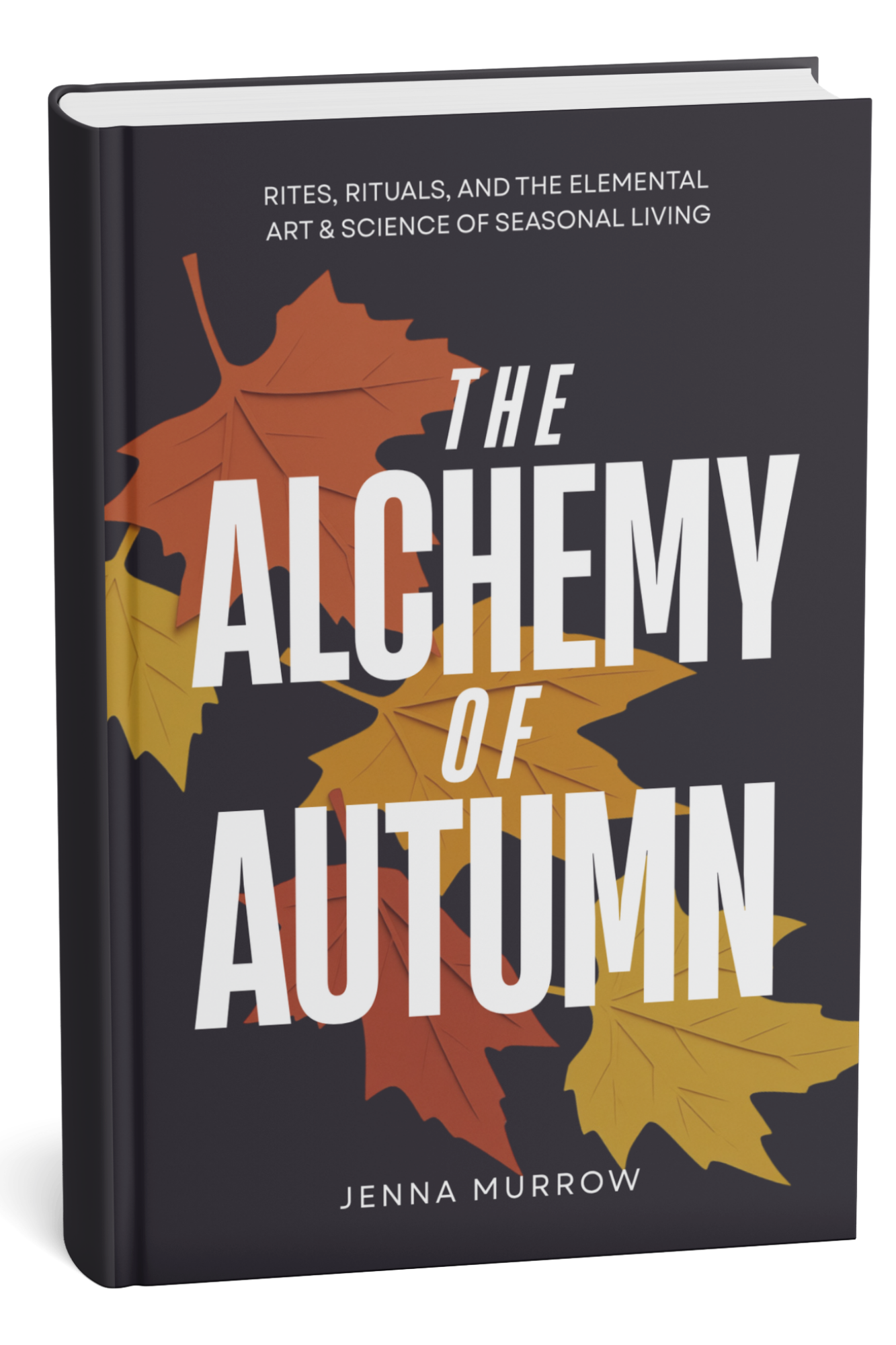

By autumn, several different kinds of change are happening at once. The days are shortening even where the afternoons are still hot. School and work schedules tighten. Gardens finish, ripen, dry out, reseed, or begin another planting window entirely. Food changes. Sleep may change. Families spend more time inside one another’s schedules again. The year has also gone on long enough for some things to become obvious: what grew, what failed, what cost too much, what needs to be finished, and what is worth carrying forward.
The Alchemy of Autumn begins there, with the season that is actually happening around you.
A calendar date can tell you where Earth is in relation to the sun; it cannot tell you whether wildfire smoke has moved everyone indoors, whether the first frost already killed the basil, whether your kitchen is still ninety degrees at dinner, or whether September blew apart a household rhythm that worked perfectly well in July. Throughout the book, astronomical autumn, local ecology, weather, the cultural calendar, constitution, and present condition are read together. The five elements give that reading another layer, following Earth, Water, Fire, Air, and Space through the body, food, weather, land, movement, work, home, ritual, and relationships.
From there the book moves into ordinary life. Food is treated as appetite, digestion, culture, labor, money, agriculture, sensory preference, and whatever the household can actually get onto the table. Movement and recovery change with temperature, light, workload, health, and the person doing the moving. Sleep shifts as daylight moves. Body care responds to dryness, heat, cold, wind, congestion, illness, or simple overload. A fall kitchen has to work on an exhausted Tuesday as well as on the afternoon somebody feels inspired to make soup from scratch.
Harvest widens the question. In the garden, something may become dinner, seed, storage, compost, or evidence that the original plan did not work. The same distinctions become useful elsewhere. The book looks at work, money, unfinished projects, household systems, invisible care labor, family archives, recipes, skills, photographs, and the difference between keeping something and preserving it in a form the future can actually use. Preparation belongs here too: repairs, clothing, food, schedules, transportation, household maintenance, and the small decisions that make the next season easier to enter.
Autumn’s ritual life grows from that material world. Harvest feasts follow harvest. Preservation intensifies because abundance has a window. Lamps and candles gain meaning as darkness comes earlier. Traditions accumulate around the dead because memory, agriculture, cosmology, religion, family history, and the turning year have met there for a very long time. The book works through the equinox, family traditions, seasonal tables and altars, ancestry, grief, inheritance, difficult family history, decomposition, and the question underneath any practice meant to survive longer than a single beautiful afternoon: what are we actually trying to remember?
Children, elders, partners, caregivers, and different constitutions within the same household get their own attention because no family enters autumn as one body. Children learn season by participating—picking, cooking, watching something rot, hearing an old story, noticing a bird disappear, carrying food to somebody who needs it. Living elders belong in the season as people with knowledge, agency, changing physical needs, and practical problems that can become harder as days narrow. Community moves through recurring meals, clubs, shared care, neighborhood traditions, third places, repair, exchange, and the repeated contact that turns an occasional gathering into something people can count on.
The final movement follows autumn all the way through itself. Early fall, deep fall, and late fall do not ask for the same things. By the end, the work has shifted from entering the season to deciding what will remain when it is over.